A Simple Solution
While working to develop a proposal that would arrest the accelerating naval arms race between the United States, Britain, and Japan, Secretary of State and head of the American delegation Charles Evans Hughes came to a pragmatic realization, concluding that basing the negotiations on arguments of potential national need would allow any party to justify increasing rather than limiting their navy, which would have resulted in the conference accomplishing virtually nothing [1]. To avoid this, Hughes based his proposal on the principle of existing strength, developing a plan that would put an end to all naval construction by the three powers, maintain the relative standing of their navies, and limit the maximum displacement any given capital ship could have [2]. To maintain this standing, Hughes had Navy officials prepare a list of British and Japanese vessels that, if scrapped, would be proportional to the United States halting its extensive naval construction program. While developing this proposal was somewhat complicated and required Hughes to consult with naval experts to determine how to measure "existing naval strength" and how to best maintain the extant relative distribution of that strength [3], what came to be known as Hughes' "stop now" proposal [4] was, at its roots, quite straightforward: in order to stop the naval arms competition, the naval powers would simply have to agree to stop competing. The efficacy of this simple solution to a complex international problem was reflected in the Five-Power Treaty it would eventually bore.
A Bipartisan Delegation for a Wary America
|
Despite the wild popularity of the disarmament movement, the prevailing mood in the United States after the first World War was one wary of international commitments that could drag America into another European war, should one erupt: only a few years earlier, the United States had refused to join the League of Nations which President Woodrow Wilson had championed. Even after the success of the Washington Conference, the United States would still largely abstain from international institutions, refusing to join the World Court in the later 1920's [5]. Sensing this mood and realizing what had doomed Wilson's bid for United States membership in the League, Hughes chose both the Senate majority leader Henry Cabot Lodge (making Lodge, who had played a major role in preventing the United States from joining the League of Nations, "part of the solution, thus preventing him from again becoming the problem" [6]) and the Senate minority leader Oscar Wilder Underwood, and would use their “intimate knowledge of the mind of Congress” to secure “the best possible assurance of the Senate’s sanction of the negotiated treaties" [6]. In addition to the two senators, Hughes recruited Elihu Root - “the great elder statesman who had been Secretary of War as well as Secretary of State and Senator from New York and who was credited with more experience and wisdom in international affairs than any other living American" [7]. In assembling this coalition, Hughes not only drew upon a wealth of knowledge in Root, but gave the treaties that would come out of the conference a strong chance at ratification by having bipartisan involvement in their negotiation. Although the Senate remained suspicious and "microscopically examined the treaties for hidden commitments" [8], Hughes' efforts to make the treaties acceptable proved successful, as each of the three major treaties negotiated at the conference would be approved.
|
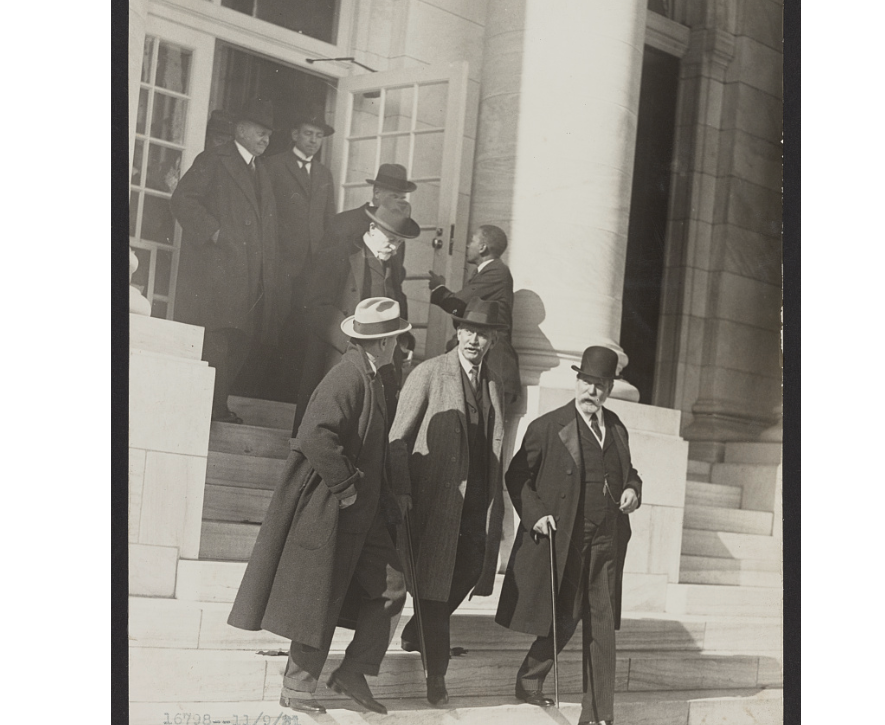
A photograph of the American delegation leaving a session of the Washington Naval Conference. Front (left to right) are Miles, Root, and Hughes, followed by Lodge and Underwood. Courtesy of the Library of Congress.
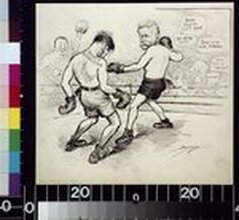
A 1922 political cartoon titled "Now you've got him" by Clifford Kennedy Berryman depicting Lodge as a boxer who is knocking out another named "Treaty Opposition." After being a part of the delegation to the Washington Conference, Lodge played a major role in getting the treaties which it produced ratified by the Senate. Courtesy of the Library of Congress.
|
________________________________________________
1. Charles Evans Hughes, David Joseph Danelski, ed. and Joseph S. Tulchin, ed. The Autobiographical Notes of Charles Evans Hughes (Cambridge, MA: Harvard University Press, 1978), 243. Accessed through HathiTrust Digital Library, https://hdl.handle.net/2027/uc1.b4903518.
2. Merlo J. Pusey, Charles Evans Hughes, vol. 2, (New York: Macmillan, 1951), 461. Accessed through HeinOnline, https://bit.ly/383x1Gm.
3. Betty Glad, Charles Evans Hughes and the Illusions of Innocence; a Study in American Diplomacy (Urbana, IL: University of Illinois Press, 1966), 273. Accessed through HathiTrust Digital Library, https://hdl.handle.net/2027/mdp.39015010853698.
4. Pusey, 461.
5. George C. Herring, From Colony to Superpower (New York: Oxford University Press, 2008), 450-52.
6. Herring, 453.
7. Hughes, Autobiographical Notes, 244.
8. Hughes, Autobiographical Notes, 247.
1. Charles Evans Hughes, David Joseph Danelski, ed. and Joseph S. Tulchin, ed. The Autobiographical Notes of Charles Evans Hughes (Cambridge, MA: Harvard University Press, 1978), 243. Accessed through HathiTrust Digital Library, https://hdl.handle.net/2027/uc1.b4903518.
2. Merlo J. Pusey, Charles Evans Hughes, vol. 2, (New York: Macmillan, 1951), 461. Accessed through HeinOnline, https://bit.ly/383x1Gm.
3. Betty Glad, Charles Evans Hughes and the Illusions of Innocence; a Study in American Diplomacy (Urbana, IL: University of Illinois Press, 1966), 273. Accessed through HathiTrust Digital Library, https://hdl.handle.net/2027/mdp.39015010853698.
4. Pusey, 461.
5. George C. Herring, From Colony to Superpower (New York: Oxford University Press, 2008), 450-52.
6. Herring, 453.
7. Hughes, Autobiographical Notes, 244.
8. Hughes, Autobiographical Notes, 247.
